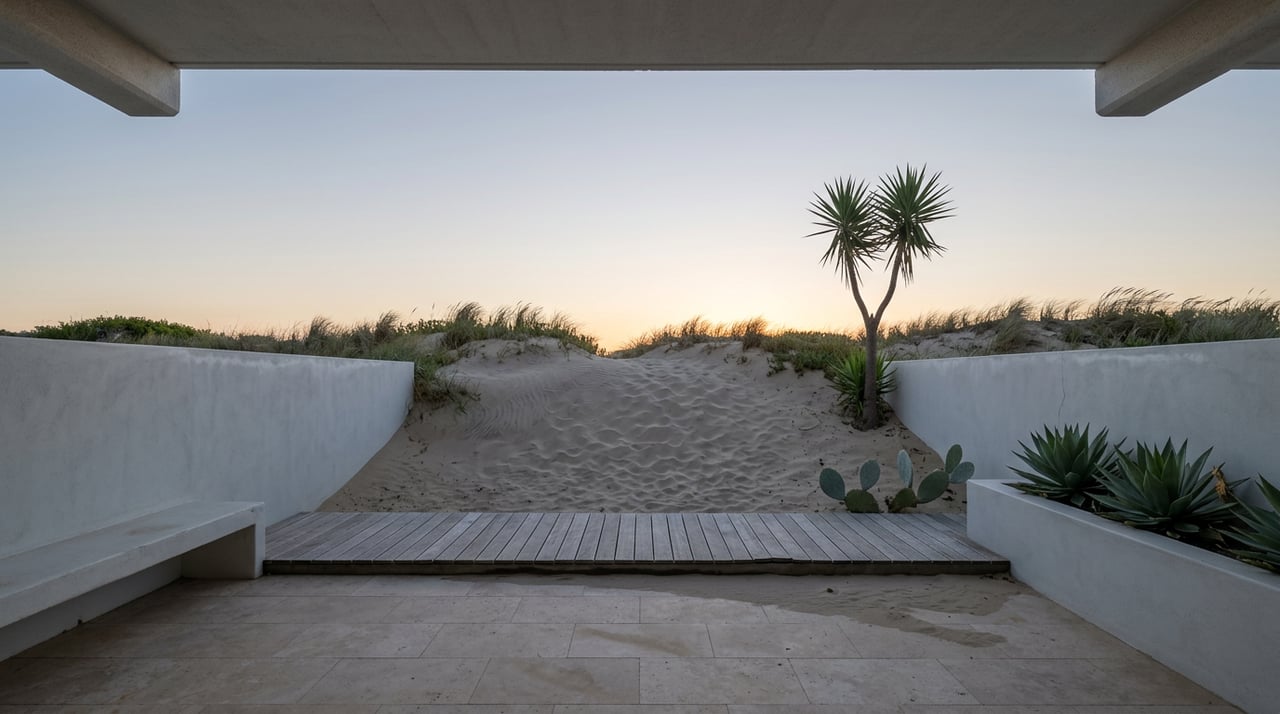
The walk from the parking area down to Acapulquito passes through a short tunnel, the kind that channels rainwater during the rare downpour and channels flip-flops the rest of the year. Come out the other side at low tide and you're stepping onto exposed reef, with urchins tucked into the cracks, the kind of terrain that rewards booties over bare feet. Come out at high tide and the same stretch is soft sand with a short, punchy shore break. Neither version quite matches the photo in Querencia's own materials, the one where a member glides across glassy water with the Beach Club's palapas in the background. That photo is real. It just isn't describing a fixed place. It's describing a narrow window on the right morning in the right month.
That's the first thing worth knowing if you live inside the gates and have only walked down to the water a handful of times: Acapulquito isn't one beach with one mood. It's at least three, and only one of them is the wave most members actually surf.
The Beach Club Isn't Wrong, It's Just Timing
Querencia's own description of the Beach Club calls Acapulquito one of Cabo's only swimmable beaches. In the same breath, it calls the spot out front the best surf break in Cabo. Both claims are true. They just describe different seasons.
Surf forecasting data for this stretch, tracked under the name Acapulquito-Costa Azul, shows summer as the reliable window for rideable waves, with May in particular producing clean, surfable conditions roughly 88 percent of the time. Winter runs calmer, which is when the beach earns its swimmable reputation. Longtime guides to this corridor note the same seasonal split: bigger waves in summer, gentler water in winter, with the shift happening gradually rather than on a fixed date.
That means a member who joined the club in December and hasn't been back in August has only ever seen the swim-beach version. Right now, in the back half of August, you're solidly inside the surf window. The water that photographs so calmly in winter is the same water currently pushing whitewater onto the sand most mornings before the wind picks up.
Old Man's Is the Forgiving One. It Has Two Neighbors That Aren't.
The wave directly in front of the Beach Club has a name surfers actually use on the water: Old Man's, sometimes just called Acapulquito. Regulars say the nickname has nothing to do with age and everything to do with the unhurried atmosphere in the lineup. It's a long, wrapping right-hand point break that rolls over a mixed reef and sand bottom, the kind of setup that gives a longboarder time to find their feet before the wave closes out. It's widely regarded as the most forgiving wave on this stretch of coastline, which is no small part of why a family-oriented beach club ended up built around it instead of somewhere more exposed.
Walk a few hundred meters east along the same sand and the water changes character twice more before you reach the arroyo:
Break | What it needs | Best suited for |
|---|---|---|
Old Man's (Acapulquito) | Works on most swells | Longboarders, beginners, lower-intermediate |
The Rock | South swell specifically | Intermediate surfers |
Zippers | South swell only | Advanced surfers, tighter-knit local crowd |
These three sit close enough that you could stand on one patch of beach and watch all three at once, but they don't behave the same way on the same day. A south swell can light up Zippers while Old Man's stays gentle enough for a first-timer. A smaller pulse might leave Zippers flat while Old Man's still has rideable shoulders rolling through. Most Beach Club members never learn any of this, because the wave at their own doorstep is the only one they've ever needed to check.
Reading the Water Before You Paddle Out
The mechanism behind a genuinely good session here is specific: a south swell paired with an offshore wind blowing from the north-northwest. When those two line up, the surface goes glassy and the waves stand up cleanly instead of crumbling into whitewash. When the wind swings onshore, which tends to happen once the day heats up, the same swell turns choppy and hard to read within an hour or two.
A quick way to tell which version of the morning you're getting:
- Clean and rideable: light or no wind at dawn, visible lines forming well outside the break, water surface holding a mirror-like sheen
- Turning blown out: whitecaps forming on the swell lines themselves, surface texture roughening even where the waves haven't broken yet, wind audible before you can feel it on your skin
That's why the useful habit for anyone living here isn't checking the surf report once a week. It's checking the water at first light and building the rest of the morning around what you see, because a swell that looked perfect on a forecast app the night before can still turn unrideable by eleven if the wind arrives early.
What's Actually Waiting for You After
The advantage of surfing at your own Beach Club instead of driving to a public access point shows up after you towel off. Querencia runs four oceanfront dining spots within a short walk of the sand, and they're not interchangeable. La Ola is the signature restaurant, built around an ocean-inspired menu with both indoor and outdoor seating. Jorge's is the quick option, a sushi and handroll counter where the fish is prepared fresh and served as is, no substitutions. Ocean Grill sits poolside with a more casual lineup of tacos, bowls, and salads, and its panoramic view happens to double as a solid whale-watching perch when the season allows. Pop's closes the loop with a retro-style dessert counter for the walk back up.
Board rentals and other non-motorized water gear, boards, snorkel equipment, stand-up paddleboards, are available right at the beach, which matters most on the mornings you didn't think to carry a board down from the house.
On the Days the Wave Isn't Worth It
Not every morning delivers a clean set. When the wind has already turned or the swell direction doesn't suit Old Man's, the better move isn't to force a session. It's to go the other direction entirely. Querencia's trail network runs more than 14 miles from the desert down to the sea, including a suspension bridge crossing one of the property's arroyos and a loop trail circling Q Lake. It's a genuinely different kind of morning, one that trades saltwater for dust and still ends at the same Beach Club no matter which direction you started in.
Knowing when to choose which one, wave or trail, swim or surf, has less to do with owning a board and more to do with reading the pattern. The tide chart matters. The wind direction at seven in the morning matters more than the swell height on your phone screen. And the version of the beach that shows up in Querencia's own photography isn't a fixed place so much as a specific set of conditions that lines up most reliably in summer, which happens to be exactly the season you're standing in right now.
If you're weighing a move into Querencia, or you already call it home and want a clear-eyed read on how a specific property sits relative to the Beach Club, the golf course, or the trail system, Jorge Gómez knows this community from the inside out. Let's Connect.